

The global market for hip and knee replacement implant will approach US$34 billion by 2036.
Hip and knee replacements are used to treat severe osteoarthritis (OA), which is one of the most disabling diseases in developed countries. The number one risk factor for OA is age, which has become a global healthcare challenge due to a worldwide aging population. However, the global market is disproportionally dominated by the US, which is expected to occupy a lion’s share of over 50% in 2026, and US-headquartered implant manufacturers will continue to lead in the increasingly competitive market landscape.
The new IDTechEx report, “Materials for Bone Implants 2026-2036: Trends, Players, and Forecasts“, provides an in-depth breakdown of the microscopic and macroscopic market drivers for implant adoption, including regional analyses dissecting the local clinical history and market trends in the US, Europe, and Asia. The report also delivers a granular 10-year forecast of the hip and knee replacement market in terms of both unit demand and market value, segmented by type and region.
The value of the hip and knee replacement implant market is determined by population, adoption rate, and implant pricing. These factors are further affected by a myriad of parameters such as demographic structure, trends in implant design, surgeon preference, etc, and each of these demonstrates significant regional variation. IDTechEx’s new report explores these factors in detail, and this article aims to provide insight on two of the key determinants: demographics and pricing.

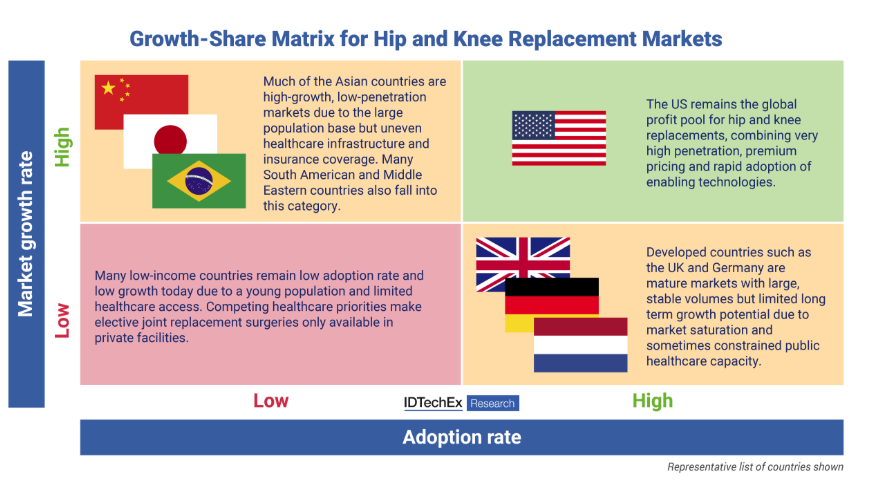
Growth-share matrix for hip and knee replacement markets. Source: IDTechEx.
Demographics is a key market driver
The rapid increase in the global population aged 60 and older is the most significant factor propelling the market. Age-related joint degeneration is the leading cause of joint replacements. Developed countries, where the geriatric population already outnumbered the juvenile, typically demonstrates high hip and knee replacement adoption rate. For example, in the UK, the annual adoption rate for hip replacement exceeds 200 per 100,000 population. However, these markets are reaching saturation and often constrained by public healthcare capacity.
On the other hand, high-income countries, although having a far larger population, are currently smaller markets due to a younger population. In addition, many low-income countries lack adequate healthcare ac