

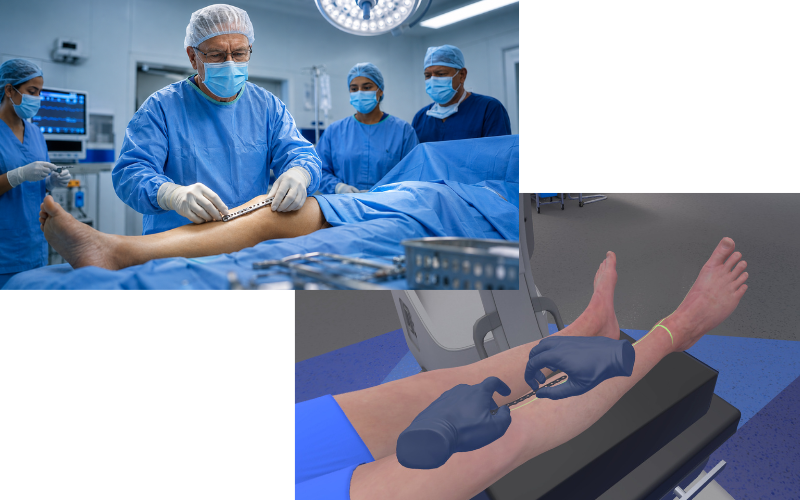
Author Danny Goel, MD, is a practicing orthopaedic surgeon and founder of PrecisionOS, whose AI-driven virtual reality platform includes fracture-fixation simulation training for orthopaedic residency programmes.
Global Market Insights puts the trauma fixation devices market at USD 9.6 billion in 2025, projects it past USD 10 billion this year, and expects USD 13.4 billion by 2035. The U.S. alone reached USD 5 billion in 2025, up from USD 4.8 billion the year before, and North America already holds 54.8% of the global market. The drivers are the ones any orthopaedic industry watcher would expect: an aging population with more osteoporosis and osteoarthritis, a steady stream of injuries from falls, road accidents, sport and workplace incidents, and a wave of new implant materials and smart, patient-specific fixation systems.
That growth curve rests on an assumption nobody has stress-tested closely enough: that there will be enough well-trained surgeons to use all of it well. The industry’s own reporting already lists post-surgical complications, implant loosening, and hardware failure among its persistent challenges. Undertrained hands make every one of those more likely, not less. The gap between rising trauma volume and shrinking hands-on surgical training isn’t just an industry risk, it’s a patient-outcomes risk, and it’s becoming one of the more consequential structural threats to fixation device adoption itself.
Rising case volume is colliding with a shrinking training pipeline
The same demographic and injury trends fuelling device-market growth are also driving up the number of trauma cases hospitals need surgeons to handle. But the pipeline producing those surgeons has been under sustained pressure for two decades, for reasons that have nothing to do with how capable or hardworking today’s residents are. Duty-hour restrictions have compressed hands-on operative time since 2003, while call coverage and other service obligations haven’t shrunk to match, so the cut has landed almost entirely on operative and educational time. Litigation caution has made attendings more conservative about handing over autonomy. Reimbursement per case has declined in real terms for years, and departments still hold faculty to the same productivity targets, pushing attendings toward doing cases themselves rather than teaching them. And many of the highest-repetition, foundational fracture cases are migrating to ambulatory surgery centers where residents are often not credentialed to operate at all.
The result is a surgical workforce entering practice with fewer independent reps than the surgeons who trained a decade or two earlier, at precisely the moment case volume is climbing to meet this market’s own growth projections. Every complication, delay, and hardware failure the industry already tracks becomes more likely as that gap widens, and patients are the ones who absorb it first.
Rising technological complexity raises the cost of getting a surgeon fully trained
The market’s own innovation compounds the problem. E