

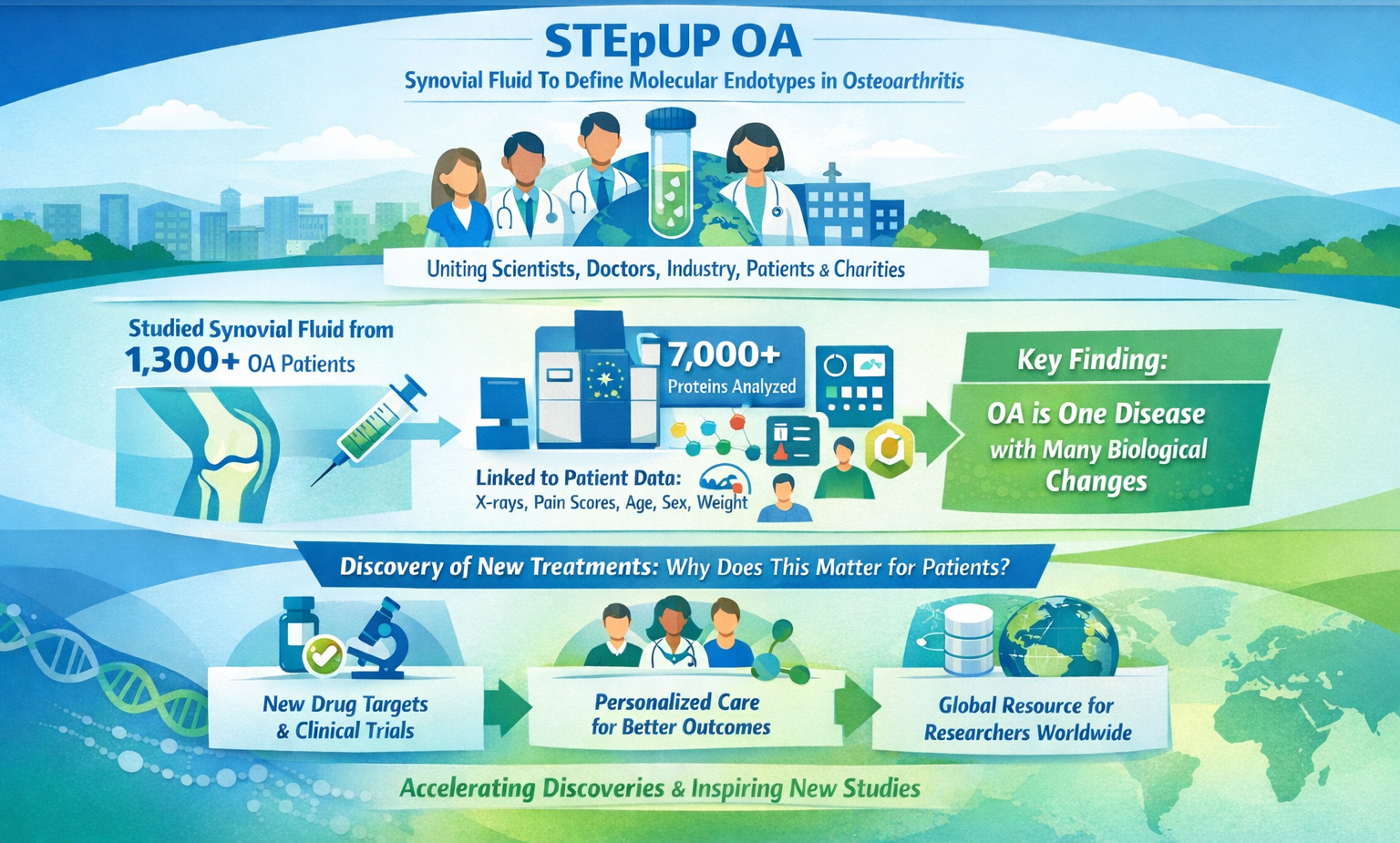
A major international study led by researchers at the Kennedy Institute of Rheumatology at the University of Oxford has found that osteoarthritis (OA) – the most common form of arthritis worldwide – is not a collection of separate diseases, as many scientists had previously speculated, but rather a single condition with common core underlying biological pathways.
Published in Nature Communications, the study represents the largest and most comprehensive molecular analysis of osteoarthritis tissue to date. The findings provide a long-awaited answer to a fundamental question that has challenged the OA field for decades and opens the door to more targeted and effective treatments for millions of people living with OA.
The STEpUP OA (Synovial fluid To detect Endotypes by Unbiased Proteomics in OA) project brought together scientists from Europe, Canada, and the UK, and includes a number of industry and charity partners. Researchers analysed synovial fluid – the lubricating fluid in the knee joint – from more than 1,300 people with established knee OA, using a cutting-edge proteomics platform (SomaScan v4.1, SomaLogic) that measured over 7,000 proteins per sample.
By comparing molecular patterns in these samples, the team sought to answer a crucial question: is OA really “one disease,” or are there multiple distinct subtypes (endotypes), each requiring its own treatment approach?
Professor Tonia Vincent, lead investigator and Director of the Arthritis UK Centre for OA Pathogenesis at the Kennedy Institute of Rheumatology (KIR), said: ‘For decades, the field has debated whether OA is really a group of separate diseases, perhaps explaining why so many clinical trials have failed. We revealed no evidence of distinct disease subtypes, instead, we’ve demonstrated that at the molecular level OA is a single disease with a common set of “core” pathways, mostly related to tissue injury and repair.’
Linked to each sample were details about the patient, such as age, biological sex, body mass index, i.e. known risk factors in osteoarthritis. By examining these patient characteristics, the study showed that while OA has a single molecular fingerprint, there is biological variation that is influenced by factors like obesity, sex, and age.
In participants with obesity, for example, the team observed additional inflammatory signals. Not immune cell driven inflammation seen in conditions like rheumatoid arthritis, but a tissue-injury response likely linked to mechanical stress. Such differences may explain why some patients progress faster or respond differently to therapies, and they could help researchers design more targeted clinical trials.
The findings may help reshape the search for effective treatments for OA, which remains one of the leading causes of disability worldwide and has no approved disease-modifying therapies.
‘This work provides a clear map of the molecular landscape of OA and offers a valuable resource for researchers and pharmaceutical companies,’ said Dr Thomas Perry, Senior post doctoral Molecular Epidemiologist at the KIR and first author of the study. ‘It will allow us to match patients to therapies much more precisely – a crucial step towards developing long-awaited treatments that slow or halt disease progression.’
The STEpUP OA dataset, which is available to the research community, is expected to drive a new wave of discovery. Scientists can use it to explore key biological pathways, identify which patients are most likely to benefit from a given treatment, and design better-targeted clinical trials, potentially reducing costs and increasing the chances of success.
Professor Lucy Donaldson, Director of Research at Arthritis UK said: ‘Understanding the biology of osteoarthritis will help us develop better, more personalised treatments for people with osteoarthritis. People experience OA differently- we know for example that peri‑menopausal women face higher risk, and that some people see their symptoms progress far more quickly than others. Understanding the mechanisms of OA is a crucial step towards understanding why the condition varies so much between individuals.’
For patients, the study provides reassurance that OA is a single disease with well-defined biological pathways, rather than a mixture of disease subtypes each with different biology. It also reinforces the importance of lifestyle factors such as weight management, since obesity is shown to amplify inflammatory signals within the joint.
‘By showing that OA biology is shared across patients, we now have a much clearer target,’ said Professor Vincent. ‘It means we can focus on therapies that address this core pathway and adapt them for people with different risk factors. This is a major step towards development of effective treatments.’
The research was a collaboration between Imperial College London, University of Nottingham, University of Cambridge, Lund University, Maastricht University, Schroeder Arthritis Institute (University Health Network, Toronto), and Western University.
The study was funded by the Kennedy Trust for Rheumatology Research, Arthritis UK and supported by industry partners including Galapagos, Biosplice, Novartis, Fidia, UCB, Nordic Bioscience, Pfizer, GSK and Somalogic.
Source: NDORMS, University of Oxford.
Image: Submitted by NDORMS, University of Oxford
